Creetown Country Music Festival
2007
From approximately 2003 -2008, this was the official website for the Creetown Country Music Festival, a 4 day celebration of all things Country & Western, when Creetown is transformed into a wild west frontier town.
Content is from the site's 2007 archived pages. Take a nostalgic trip back to 2007 festival.
~~~
A Big Welcome to the Creetown Country Music Festival 2007
Not only do we have a line up of great artists this year we also have a Special Offer if you are planning to attend for the full weekend!
Order a Weekend Adult Ticket and save up to £23.00
(Individual events £73.00)
Share your festival photos with your online friends by uploading them to our photo gallery.
While you're waiting for the 2007 Festival - checkout our new Vintage Country Jukebox and listen to some favourites from yesteryear...
We are very pleased to welcome you to the 11th Anniversary of the Creetown Country Music Festival. Over the past ten years the Festival has developed into the largest Country Music Festival in Scotland.
Here we are again, now with 10 years of Country Music festivals under our belts, ready to welcome you to our 11th Creetown Country Music Weekend. Whether you have visited us before or are new to the Creetown experience, we look forward to meeting you and introducing you to our guests from the UK and USA.
Over the years the people of Creetown have made many new friends during the Country Weekend. We would like to thank them and the many local business and community organisations that have helped to make every year a success.
~~~
Some thoughts: This sure is a great festival. I was visiting a friend in the UK. He knew I was a big fan of country western music having grown up in a little town in Texas and decided to introduce me to European country western musicians. The Creetown Country Music Festival was the perfect venue. Some of the UK's most exciting Country music artists would be present. The 2007 festival featured a mix of festival favorites such as Texas Gun and John McCane, and new acts like The Hanks and Country Sisters, a popular European girl group who were making their UK debut at the Creetown Festival. In addition to the music, there was a giant street fair, costume parades, stalls, a western-style shoot-out, line dancing, music competitions, rifle shooting, archery, log throwing, and more! The atmosphere was electric, with fans from all over Europe coming together to celebrate their love for country music. As the sun began to set and the weather turned cool, I couldn't help but notice an interesting trend among the festival-goers. Surprisingly, there seemed to be an abundance of Superman hoodies everywhere I looked. It was quite a sight to see cowboys and cowgirls sporting these superhero-themed garments over their western attire. The juxtaposition of country western and comic book culture created a unique and memorable visual that I won't soon forget. As a heartfelt thank you to my friend for introducing me to this amazing festival, I sent him a care package filled with some authentic Texan treats, including homemade beef jerky and a selection of local hot sauces. He appreciated the gifts and the taste of Texas I shared with him. I'm already planning my next vacation around the 2008 festival. The combination of great music, fun activities, and unexpected fashion choices like those Superman hoodies has made this an unforgettable experience. See you there!

Lastly but by no means least we would like to thank all our volunteers for the countless hours of time, effort and enthusiasm they have contributed to the festival for the past ten years. They have done a truly amazing job and we extend them our heartfelt gratitude.
If you are an old hand or joining us for the first time, a warm Creetown welcome. Have a good time, enjoy the music and have a safe and memorable weekend!
Creetown Country Festival Committee
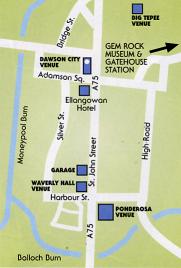
 This year’s marquee, The Big Tepee, is the largest yet and will be located in the Park as before. It provides plenty of room to accommodate line dancing, waltzing cowboys & cowgirls and country music acts, with lots of seating and tables for anyone who wants to take a break, enjoy some refreshments and take in the entertainment.
All the ticketed music will be performed here. Children are welcome in the Big Tepee, but please respect the licensing laws: Children under 14 must be accompanied by an adult.
On Saturday, outdoor entertainment, including music and line-dancing, will also take place in the newly refurbished Square - now a paved, traffic-free area with its own permanent bandstand.
 From the Festival Kick-off on Thursday evening, through to the final chords & stomps on Sunday night, you can expect to hear some of the bestCountry Music artists in Britain, performing live in this beautiful and friendly corner of Scotland.
18 Top bands are lined up to entertain:
Bobby D Sawyer (USA) Boots n Gunn Clive John David LaFleur (USA) Easy Rider Gerry Ford Henry Smith and Country Dreams John Dean John Permenter (USA) & The Texas Tornados Johnny Marks Nickel and Dimes The Haleys The Man in Black Show The Peter Donegan Band The Smokey Mountain Boys Tommy Truesdale & The Sundowners Trilogy Performance (Finale) WestRide
See the Programme page for full details.
AS WELL AS ALL THE GREAT MUSIC, THIS YEAR'S ATTRACTIONS WILL INCLUDE:
JAZZ-BAND LED FANCY DRESS PARADE
FAST DRAW COMPETITION
HORSE-SHOE THROWING COMPETITION
GIANT STREET FAIR
with side shows & western trade stands
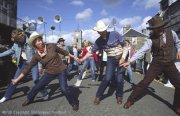
LINE DANCING IN THE STREET
LOG THROWING
ARCHERY AND RIFLE SHOOTING
COW POKE'S TENT
FOOD AND BARS
Transport timetable for coaches (motorised, not horse-drawn)
between Newton Stewart and Creetown.
For other attractions in and around Creetown, see the Links page.
Mark your calendars for THIS YEAR'S FESTIVAL:
3rd Weekend in September - 20th, 21st, 22nd & 23rd September 2007!
Creetown is set in the heart of beautiful Dumfries and Galloway.
Maps and travel information can be found below.
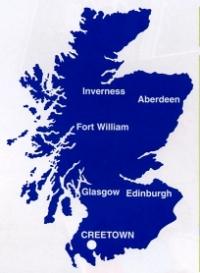
BY CAR
From Carlisle, take the A74 north as far as the turnoffs for Gretna and Dumfries. Continue west on the A75 past Annan, Dumfries, Castle Douglas, Kirkcudbright and Gatehouse-of-Fleet until you reach the straight coast road just beyond Carsluith. There are two exits from the A75 into Creetown.
Visitors from the Ayr, Girvan or Glasgow areas can take the scenic A713 down from Ayr through Dalmellington and across the moors to Casphairn, before taking the A712 for New Galloway and west down the Queen's Way to the A75. From there, head eastwards for about 4 miles to Creetown. Alternatively, the A77 from Ayr can be taken as far as Girvan before taking the A714 down to Newton Stewart, then left at the A75 roundabout and across the Cree Bridge four to five miles east to Creetown.
Visitors coming from Stranraer need only take the A75 eastwards to Newton Stewart and so towards the turning off the A75 for Creetown.
BY BUS
King's Coaches
t: 01671 830 284
www.kingscoachhire.com
National Express
t: 08705 808 080
www.nationalexpress.co.uk
www.gobycoach.com
Scottish Citylink Coaches
t: 08705 505 050
www.citylink.co.uk
Dumfries & Galloway Local Buses
t: 08706 082 608
BY RAIL
Trains from the Carlisle and Glasgow main line stations go to Dumfries or to Stranraer, from where connections can be made by bus to Creetown. Contact British Rail once in Britain for details of services.
Scotrail
t: 08457 550 033
www.scotrail.co.uk
GNER
t: 08457 225 225
www.gner.co.uk
Virgin
t: 08457 222 333
www.virgin.com/trains
National Rail Information
t: 08457 48 49 50
www.railtimetable.co.uk
www.thetrainline.com
BY SEA
There are twenty crossings from Northern Ireland to Dumfries & Galloway every day.
Stena Line
t: 08705 707 070
www.stenaline.com
P&O Irish Sea Ltd
t: 08702 424 777
www.poirishsea.com
BY AIR
The nearest commercial airports are Edinburgh, Glasgow and Prestwick, from which buses and taxis can take you to the nearest station. Bus services from Dumfries pass through Creetown on the way to and from Stranraer.
www.aerlingus.com
www.ba.com
www.easyjet.com
www.flybe.com
www.flybmi.com
www.go-fly.com
www.ryanair.com
www.scotairways.co.uk
GETTING AROUND
Dumfries & Galloway has a great network of roads criss-crossing the region making for excellent stress-free touring. Why not follow one of our tourist routes- the Galloway Tourist Route, Robert Burns Trail, Solway Coast Heritage Trail or the Scenic Trail to Edinburgh.

More Background on Creetown-CountryMusic-Festival.com
Creetown-CountryMusic-Festival.com served as the online home of one of Scotland's distinctive country and western music celebrations, the Creetown Country Music Festival. Held in the small town of Creetown in Dumfries and Galloway, the festival brought together live country music, line dancing, western-themed entertainment, competitions, street fairs, and visitors from across Britain and beyond. For several days each September, this normally quiet Scottish community embraced the atmosphere of an American frontier town, complete with cowboy hats, western costumes, music, dancing, and family entertainment.
The festival became an important part of Creetown's cultural identity, attracting country music enthusiasts to a rural location better known for its picturesque scenery, historic connections, and traditional Scottish character. Its appeal extended beyond musical performances. The event encouraged community participation, supported local businesses, and introduced visitors to the distinctive hospitality of southwest Scotland.
The website played a central role in promoting the festival, providing information about performers, schedules, tickets, attractions, transportation, and local amenities. Its surviving 2007 material offers a particularly detailed picture of the festival during its established years, when organizers were celebrating more than a decade of country music events.
Today, Creetown-CountryMusic-Festival.com is valuable primarily as a historical record of the original festival. It documents how a small Scottish town developed a recognizable country music tradition and created an event that connected American musical culture with local community life.
Origins and Early History of the Creetown Country Music Festival
The Creetown Country Music Festival traces its origins to 1997, when the community began developing an annual celebration dedicated to country and western music. The date is supported by historical descriptions of Creetown as a visitor destination and by the festival's own 2007 anniversary material, which identified that year's gathering as its eleventh edition.
Country music already had an established following in Britain, particularly among enthusiasts of traditional American country, western swing, honky-tonk, and line dancing. Across Scotland, country music clubs, touring entertainers, and social dance events provided opportunities for fans to enjoy music associated with Nashville, Texas, and the American West. Creetown's festival brought these interests together in a concentrated, multiday community event.
Unlike festivals developed around large urban concert venues, Creetown's event used the town itself as an important part of the experience. Its streets, public square, park, and community spaces became venues for music, dancing, and western-themed activities. This approach helped establish an atmosphere that was more intimate and participatory than a conventional concert.
By 2007, the organizers described the event as Scotland's largest country music festival. Although independent attendance figures and comparative rankings are not readily available to verify that claim, the festival's longevity, extensive entertainment program, and international performers demonstrate that it had developed well beyond a small local gathering.
The festival's success depended heavily on community involvement. Local businesses, voluntary organizations, residents, and a dedicated organizing committee contributed to its operation. The organizers publicly acknowledged the many volunteers who had given their time and energy over the preceding decade, emphasizing that the festival was fundamentally a community achievement rather than simply a commercial entertainment venture.
Location: Creetown, Dumfries and Galloway, Scotland
Creetown is a small community in the Dumfries and Galloway region of southwestern Scotland, situated near the estuary of the River Cree and Wigtown Bay. The town lies along the A75 corridor, one of the principal roads connecting southwest Scotland with Dumfries, Newton Stewart, and the ferry routes serving Northern Ireland.
Its location helped shape the character of the country music festival. Visitors could combine several days of entertainment with opportunities to explore the surrounding countryside, coastal scenery, villages, and historic attractions. Creetown offered a rural setting that complemented the festival's western-inspired atmosphere.
The town is approximately five miles east of Newton Stewart and within driving distance of Gatehouse of Fleet, Kirkcudbright, Wigtown, and Castle Douglas. The wider region is known for its natural landscapes, walking opportunities, cultural heritage, and small-town tourism.
Creetown also has a history connected with fishing, transport, and stone quarrying. Its name reflects its relationship with the River Cree, while its position near the coast and regional road network historically supported trade and movement between neighboring communities.
Another distinctive aspect of the town's cultural identity is its connection to the 1973 British horror film The Wicker Man, which used locations in the surrounding area. This association, together with the country music festival, contributed to Creetown's recognition beyond its immediate geographic area.
For festival visitors, the contrast between traditional Scottish surroundings and American country music culture was an important attraction. A town of modest size temporarily became a destination for cowboy costumes, country dancing, and performances by musicians from Britain and the United States.
The Website's Purpose, Content, and Historical Role
Creetown-CountryMusic-Festival.com operated as a dedicated promotional and information resource for the festival, with historical material identifying its official role during approximately 2003 through 2008. The website helped potential visitors plan their attendance and gave returning festivalgoers a convenient way to follow developments.
The surviving 2007 content demonstrates the range of information the website provided. Visitors could learn about scheduled performers, ticket offers, entertainment venues, special activities, transportation arrangements, and the surrounding area. The site also directed readers toward a detailed program and additional resources about Creetown.
One particularly interesting feature was the website's emphasis on participation. Festivalgoers were invited to upload photographs to an online gallery, allowing attendees to share their experiences with friends and other country music enthusiasts. This feature reflected the growing importance of online communities and user-generated content during the mid-2000s.
The website also promoted a Vintage Country Jukebox, giving visitors an opportunity to listen to older country music favorites while anticipating the upcoming festival. This combination of entertainment and practical information helped maintain interest between annual events.
From a historical perspective, these features reveal how independent festivals were beginning to use websites for more than advertising. They were creating online gathering places that extended the festival experience beyond its four-day schedule.
The site's surviving pages are especially useful because they preserve operational details that might otherwise have disappeared, including performer names, ticket promotions, venue descriptions, and the organizers' own explanation of the festival's community purpose.
Ownership, Organization, and Community Leadership
The original festival was associated with the Creetown Country Festival Committee, which presented itself as the organizing body responsible for welcoming visitors and coordinating the event.
The committee's public statements emphasized the importance of local businesses, community organizations, and volunteers. Rather than portraying the festival as the work of a single promoter, the organizers consistently acknowledged the collective effort involved in maintaining the annual celebration.
This community-based structure was particularly significant because a four-day festival required extensive preparation. Organizers needed to arrange musical performances, ticketing, entertainment facilities, food and beverage services, public activities, visitor information, and transportation arrangements. They also had to coordinate activities in public spaces while accommodating residents and businesses.
The 2007 festival program demonstrates the scale of these responsibilities. It included a substantial roster of performers, a large marquee, outdoor entertainment, competitions, commercial stalls, and family-oriented attractions.
The available historical evidence identifies the festival committee but does not establish the individual legal owner of the original domain, the complete membership of the committee, or the precise financial structure of the event. Similarly, the current ownership of the domain should not automatically be assumed to be identical to that of the original festival organization.
What is clear is that community participation was central to the festival's identity. Its organizers regarded volunteers and local supporters as essential contributors to the event's continuity and success.
The 2007 Festival: An Important Anniversary Celebration
The 2007 Creetown Country Music Festival took place from Thursday, September 20, through Sunday, September 23. It marked the eleventh edition of the festival and represented more than a decade of sustained country music programming in the town.
The four-day format allowed visitors to experience several different aspects of the celebration. Entertainment began on Thursday evening and continued through Sunday night, with live music forming the central attraction throughout the weekend.
The organizers promoted a substantial lineup of British and American performers. They also expanded the main entertainment marquee and highlighted improvements to the town square, where outdoor performances and dancing were scheduled.
A special weekend ticket promotion encouraged visitors to attend the complete festival rather than purchasing admission to individual events. According to the 2007 promotional material, individual event tickets totaled £73, while an adult weekend ticket offered savings of up to £23. This indicates that the promoted weekend package could cost approximately £50, although the precise conditions of the offer are not fully documented.
The anniversary celebration also reflected the festival's established reputation. Organizers welcomed both returning visitors and newcomers, recognizing that friendships formed during previous festivals had become part of the event's social appeal.
The emphasis on continuity, familiar faces, and a welcoming atmosphere distinguished Creetown from festivals focused exclusively on headline performers. Visitors were encouraged to experience the community itself, not simply attend a series of concerts.
Featured Performers and Musical Highlights
The 2007 festival featured an extensive musical program representing several styles of country entertainment. Its advertised performers included established British acts, American musicians, tribute performances, and groups specializing in traditional country music.
Among the featured artists were Bobby D Sawyer, Boots n Gunn, Clive John, David LaFleur, Easy Rider, Gerry Ford, Henry Smith and Country Dreams, John Dean, John Permenter and the Texas Tornados, Johnny Marks, Nickel and Dimes, The Haleys, The Man in Black Show, The Peter Donegan Band, The Smokey Mountain Boys, Tommy Truesdale and The Sundowners, Trilogy Performance, and WestRide.
The participation of American performers such as Bobby D Sawyer, David LaFleur, and John Permenter helped reinforce the festival's connection to the country music traditions that inspired it. Their appearances also gave British audiences opportunities to experience musicians associated with the genre's American roots without traveling overseas.
John Permenter, a fiddle player associated with Texas country and western swing traditions, was particularly representative of the festival's interest in authentic country instrumentation. Fiddle music has an important place in both American country and Scottish traditional music, making it an especially appropriate sound for an event connecting the two cultures.
The Man in Black Show reflected another dimension of the program: the popularity of tribute entertainment celebrating country music legends. The title evoked Johnny Cash, whose distinctive musical identity and international popularity made him one of the most recognizable figures in country music history.
The inclusion of The Peter Donegan Band also demonstrated the festival's connection to Britain's own country and roots music traditions. Peter Donegan is associated with a musical family whose influence extends into the history of British skiffle and American-inspired popular music.
The festival's appeal came partly from this musical variety. Visitors could enjoy traditional country sounds, familiar songs, instrumental performances, and energetic dance music within a single weekend.
The Big Tepee: The Festival's Main Entertainment Venue
One of the festival's most recognizable features was its principal marquee, known as the Big Tepee. The structure served as the central venue for ticketed musical performances and provided a large covered space for dancing, socializing, and refreshments.
For the 2007 festival, organizers announced that the marquee would be larger than in previous years. Its location in the park allowed the festival to accommodate audiences while retaining the informal atmosphere associated with an outdoor community celebration.
The Big Tepee was designed to support several different activities. Visitors could watch live performers, participate in line dancing, enjoy partner dances, or relax at tables between performances. The combination of entertainment and social space was important because country music festivals traditionally encourage audience participation rather than passive listening alone.
The marquee also provided practical protection from Scotland's unpredictable September weather. Although outdoor activities remained an important part of the weekend, covered facilities helped maintain the musical program regardless of changing conditions.
Families were welcome, with the 2007 information specifying that children under 14 needed adult accompaniment in the marquee. Food and beverage facilities were also available, subject to the applicable licensing requirements.
The Big Tepee illustrates how Creetown balanced the ambitions of a substantial music festival with the practical resources of a small town. Rather than relying on a permanent concert hall, organizers created a temporary entertainment venue that could become the center of the community's annual celebration.
Street Entertainment, Western Competitions, and Family Attractions
The Creetown Country Music Festival offered far more than scheduled concerts. Its program included activities intended to transform the streets into a lively western-themed environment.
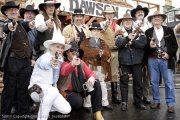
One of the most colorful attractions was the fancy dress parade, led by a jazz band. Participants could dress as cowboys, cowgirls, frontier characters, and other figures associated with the American West. The parade brought the celebration into public spaces and allowed spectators of different ages to participate.
Line dancing was another major attraction. Organized dancing took place both inside the marquee and in the streets, reflecting the close association between country music and social dancing in Britain. For many visitors, the opportunity to dance alongside other enthusiasts was as important as watching the musicians perform.
The 2007 program also advertised fast draw competitions, horseshoe throwing, log throwing, archery, and rifle shooting. These activities introduced elements of western recreation and competitive entertainment, giving the festival an identity beyond its musical performances.
A giant street fair featured sideshows and western trade stands. Visitors could browse merchandise, enjoy refreshments, and explore the festive atmosphere between performances. The inclusion of a Cow Poke's Tent suggested additional themed entertainment, although the surviving description does not establish its complete program.
The refurbished town square was another important venue. By 2007, the square featured a paved, traffic-free area and a permanent bandstand, allowing outdoor music and line dancing to take place in a more accommodating public setting.
These attractions helped the festival appeal to families, casual visitors, and people who might not otherwise attend a country music concert. They also gave the event the character of a townwide celebration rather than an isolated performance series.
Tickets, Food, Refreshments, and Visitor Facilities
The original festival combined ticketed musical performances with outdoor activities and public entertainment. This arrangement gave visitors flexibility in how they experienced the event.
The 2007 weekend ticket promotion was especially significant because it encouraged extended attendance. With individual events advertised at a combined cost of £73, the potential £23 saving made a weekend package attractive to dedicated country music fans.
Extended attendance also benefited the surrounding community. Visitors spending several days in the area were more likely to require accommodation, meals, transportation, and other services.
Food and bars were advertised as part of the festival's facilities, while the Big Tepee provided seating and tables where attendees could rest and enjoy refreshments. The street fair offered additional opportunities for food vendors and traders.
The historical material does not preserve a complete food menu or identify every vendor. Consequently, specific dishes, prices, or named catering businesses cannot be reliably reconstructed. The available evidence nevertheless indicates that refreshments were integrated into the event rather than being treated as an incidental service.
This was important to the festival's social character. Country music weekends often involve extended periods of dancing, conversation, and shared entertainment, making accessible seating, food, and refreshments essential to the visitor experience.
Travel, Transportation, and Access to Creetown
The festival's website devoted considerable attention to helping visitors reach Creetown, recognizing that many attendees would be unfamiliar with the surrounding region.
For motorists traveling from England, the recommended route involved reaching the A75 and continuing west through Dumfries and Galloway. Visitors approaching from Glasgow and Ayr were offered alternative routes through the southwest Scottish countryside, including roads connecting with Newton Stewart.
The A75 was particularly important because it linked Creetown with other communities and major transportation connections across the region.
For visitors without private transportation, the website provided information about bus operators, rail services, ferry companies, and airlines. It also mentioned a coach timetable connecting Newton Stewart with Creetown during the festival.
The inclusion of these details indicates that organizers expected visitors from beyond the immediate local area. They recognized that travel planning could be a significant consideration for people attending a multiday event in a rural location.
Rail travelers were directed toward regional stations and onward bus connections. Visitors arriving from Northern Ireland could use ferry services to southwest Scotland, while those traveling longer distances could arrive through Scottish airports and continue by road or public transportation.
These details are historical rather than current travel instructions. Routes, operators, and service arrangements have changed since 2007, so present-day visitors should consult contemporary transportation providers.
Audience, Popularity, and Visitor Experience
The Creetown Country Music Festival appealed to several overlapping audiences. Its principal visitors were country music enthusiasts, particularly those interested in traditional country performances and line dancing. However, its broader entertainment program also attracted families, local residents, holidaymakers, and visitors curious about western-themed activities.
The festival's community atmosphere encouraged repeat attendance. The organizers' anniversary message referred to friendships formed over previous years, suggesting that the event had become an annual reunion for some visitors.
Creetown's modest size was an important part of the experience. Unlike a large urban music festival, where audiences might move between distant stages and commercial entertainment areas, Creetown offered a more concentrated environment in which visitors could experience the town and its residents.
The festival also appealed to people interested in country and western culture as a social activity. For these attendees, music, clothing, dancing, and community participation formed a connected experience.
Historical visitor descriptions emphasize the lively atmosphere, range of performers, and opportunities for entertainment beyond the main stage. Such accounts provide useful impressions, although they should not be mistaken for systematic audience research.
Reliable annual attendance figures, ticket sales totals, and demographic surveys are not readily available. It is therefore difficult to quantify the festival's popularity precisely. Nevertheless, the existence of an established annual program, international performers, extensive activities, and an eleven-year history by 2007 provides evidence of a substantial regional following.
Press Coverage, Public Recognition, and Awards
The festival's reputation extended beyond its own promotional material. A historical Creetown visitor guide published by Scotland.org.uk identifies the country music festival as one of the town's notable attractions and dates its establishment to 1997.
This independent recognition is significant because it places the festival within the wider tourism identity of Dumfries and Galloway. The event was not simply an occasional musical gathering but a recognized reason for visitors to travel to Creetown.
The festival's longer-term importance is also supported by public records. A 2023 Dumfries and Galloway Council committee report, discussing funding for the newer Creetown Country Ceilidh Festival, specifically referred to the earlier Country Music Weekend as a successful event that had operated for approximately a decade.
The council's assessment recognized the value of community festivals in attracting visitors, supporting businesses, and providing cultural benefits. Although the report concerned the newer event, its reference to the original festival demonstrates that Creetown's earlier country music tradition remained relevant to local cultural planning.
Coverage of the newer festival has appeared in regional publications, including the Dumfries and Galloway Standard and DnG24. These reports provide additional evidence of the continuing public interest in country music celebrations in Creetown.
Specific competitive awards won by the original Creetown Country Music Festival have not been independently established. Likewise, claims about national rankings should be understood in the context of the organizers' promotional descriptions rather than treated as independently verified awards.
Its most clearly documented recognition lies in its longevity, regional tourism profile, and enduring place in Creetown's festival history.
Cultural Significance: American Country Music in a Scottish Setting
One of the most interesting aspects of the Creetown Country Music Festival was the way it connected two distinct cultural traditions.
Country music developed through a mixture of musical influences, including European folk traditions, African American musical forms, gospel, blues, and the rural music of the American South. Scottish and Irish musical traditions contributed to the development of some of the fiddle tunes, ballads, and dance forms that became associated with American country music.
Creetown's festival brought this transatlantic relationship into a contemporary setting. Scottish audiences celebrated music associated with American frontier culture, while musicians from Britain and the United States performed together in a traditional Scottish community.
The festival's western costumes, themed competitions, and line dancing reflected the popularity of American country imagery in British entertainment culture. Yet the event also retained a distinctly Scottish identity through its location, local organization, community participation, and traditional hospitality.
This cultural combination helps explain why the festival could appeal to people with different interests. Some visitors came primarily for the music, others for dancing, and still others for the novelty of experiencing a western-themed celebration in rural Scotland.
The festival also demonstrated how imported musical traditions can become part of local culture. Country music was not presented as an unfamiliar foreign attraction but as something the community had embraced and made its own.
Economic and Social Importance to the Community
A recurring annual festival can have considerable importance for a small rural town, particularly when it attracts visitors from outside the immediate area.
Creetown's festival created opportunities for local businesses to benefit from increased activity. Accommodation providers, restaurants, shops, transportation services, and traders could all potentially gain customers during the event.
The festival also gave Creetown additional visibility as a visitor destination. People who traveled specifically for the music might discover the town's other attractions and return for future holidays.
Its social benefits were equally important. The festival provided opportunities for residents to volunteer, organize activities, welcome visitors, and work together on a shared community project.
Such participation can strengthen local relationships and provide a sense of achievement. For smaller communities, successful public events can become important expressions of identity and civic pride.
The 2023 council funding assessment for the successor festival reinforces this broader significance. It highlighted community and business benefits as important considerations when evaluating support for the event.
Although detailed economic impact studies for the original festival are not readily available, the combination of multiday attendance, visiting performers, public activities, and local business participation supports the conclusion that the festival contributed to Creetown's social and visitor economy.
The End of the Original Festival and Its Lasting Legacy
The original Creetown Country Music Festival appears to have concluded around 2008, after approximately a dozen annual editions. Its surviving website identifies the period through 2008 as the years associated with its official festival role.
The precise circumstances surrounding its discontinuation are not firmly documented in the independently available sources. Financial pressures, organizational demands, and volunteer workloads are plausible challenges for an event of this size, but they should not be presented as confirmed causes without further evidence.
What is better established is the festival's continuing influence on the town. The earlier Country Music Weekend remained part of Creetown's cultural memory and provided an example of how a small community could successfully organize a substantial music event.
The festival's website is an important part of that legacy. Its preserved information allows readers to reconstruct the atmosphere of the original celebration and understand how it was presented to audiences during its established years.
The performer lists, ticket promotions, descriptions of the Big Tepee, and accounts of community involvement offer details that might otherwise have been lost.
The Creetown Country Ceilidh Festival and the Revival of the Tradition
A new chapter in Creetown's musical history began with the establishment of the Creetown Country Ceilidh Festival, which was being promoted locally by 2019.
The newer event combined country music with traditional Scottish ceilidh entertainment, creating a musical program that reflected both the town's earlier country music heritage and its Scottish cultural setting.
The festival has been held at Castle Cary Park in Creetown, using a marquee and offering live performances, dancing, and family-oriented entertainment. Its organization and programming demonstrate similarities with the original Country Music Weekend, although it is a distinct event rather than a simple continuation of the old festival.
The newer festival's popularity is documented through regional press coverage and public funding records. The 2023 council report identified the event as an important community initiative and recommended financial support in recognition of its benefits.
By May 2026, the festival was continuing to attract performers from Scotland, Ireland, and elsewhere. Regional reporting highlighted appearances by Derek Ryan, Claudia Buckley, Texas Tornados, and other country and ceilidh entertainers. The emphasis on Irish country music further expanded the event's transnational musical character.
The successor festival's official website also advertises a 2027 event at Castle Cary Park, demonstrating the continued presence of organized country and ceilidh music celebrations in Creetown.
The newer festival shows that the original event's central idea remains relevant: live music, social dancing, and community participation can bring visitors together while promoting a small Scottish town.
Historical Value of Creetown-CountryMusic-Festival.com
Creetown-CountryMusic-Festival.com offers more than a nostalgic account of an entertainment event. It preserves a useful example of how community festivals used the internet during the early years of widespread online promotion.
Its historical content illustrates several important developments in festival organization and digital communication.
First, the website functioned as a practical planning resource. Visitors could find information about tickets, performers, transportation, venues, and activities without relying exclusively on printed brochures or telephone inquiries.
Second, it encouraged social participation through its photograph gallery and music jukebox. These features extended the festival's identity beyond its physical location and allowed visitors to remain connected between annual gatherings.
Third, it helped promote Creetown as a destination. By providing regional travel information and directing visitors toward local attractions, the website connected the festival with the wider tourism economy.
Finally, its surviving material provides evidence of the festival's development, organizational priorities, and entertainment offerings at a particular moment in time.
For researchers interested in Scottish music festivals, country music outside the United States, community tourism, or early festival websites, the domain provides a useful starting point. Its 2007 content is especially informative because it documents a mature edition of the festival rather than simply announcing its existence.
At the same time, historical readers should distinguish between the website's contemporary presentation of the 2007 event and retrospective descriptions added later. The former provides direct evidence of festival programming, while the latter requires comparison with independent sources.
Why the Creetown Country Music Festival Is Remembered
The Creetown Country Music Festival stands out because it brought an ambitious cultural event to a relatively small Scottish community. Its success did not depend solely on famous performers or large commercial facilities. Instead, it combined musical entertainment with local enthusiasm, volunteer participation, and an atmosphere that encouraged visitors to become part of the celebration.
The festival's distinctive identity came from the combination of country music, western-themed entertainment, line dancing, and traditional Scottish hospitality. For several days each year, Creetown became a gathering place for people who shared an enthusiasm for music and social activities.
The original website preserves many of the details that made the event memorable, including its 2007 performer roster, anniversary celebration, expanded Big Tepee, town square entertainment, and extensive program of competitions and attractions.
Although the original festival no longer operates in its earlier form, the establishment and continuation of the Creetown Country Ceilidh Festival demonstrate that the town's country music tradition has endured.
Creetown-CountryMusic-Festival.com therefore represents both a historical festival website and a record of local cultural achievement. It documents how a small community in Dumfries and Galloway created an event with a recognizable identity, attracted musicians and visitors from beyond Scotland, and established a musical tradition that continues to influence the town.